How statistics are changing the way we look at the game
Summary
If we look at the ranking of the teams in the last EHF EURO2020 and compare it with the current EHF EURO2022, we observe that teams, which were in the top six places at the finals, Portugal and Slovenia, for example, see their course finish earlier in this European tournament in the last places, 19 and 16 respectively, and others being previously in the bottom places, jumping to the Main Round, such as Poland (21) and Russia (22).
What can explain these variations in a short two-year period?
Digitalization Era
In the age of digitization, for which handball seems to be moving in the right direction, the idea of “Moneyball” will be flourishing among analysts. Maybe not so much in recruitment, but it can be a matter of time.
Statistics and video analysis are attractive tools to me, and back then, I used them with my teams, considering them very useful and essential. At that time, I picked the coding from the Swedish League ( Statistik – Handbollsligan (handballstats.se ) still, actual today, to establish an individual ranking (MEP) within my teams and thus have a holistic view of each player.
The Βundesliga ( liquimoly-hbl.de) is currently applying the Handball Performance Index (HPI), a tool introduced in handball by the Handballlytics ( Start (EN) – Handballytics ). Their staff have done an excellent job in normalizing the entire collected data, which allows players to be classified and compared based on their performance in the past,the present and projecting the future.
But they are doing much more. Stop by to check it out !
Nowadays, there are several sources from which we can collect varied information, whether graphics, video, or big data. The same happens with the video recording, analyzing, and sharing data about our players and opponents. Since 2008, the video analysis has been passed on to another level and a large part of teams and leagues are nowadays also using XPS Network ( Sideline Sports Blog | Sideline Sports ), a Sidelinesports ( Sideline Sports ) super tool that allows the organization planning, analysing and communicating between staff and players about sensitive information at all levels. Furthermore, it is a powerhouse when it comes to video analysis.
InStat ( instatscout.com ) staff has also done game analysis work, producing high-quality documents and building a huge database that supports standards and offers relevant clues for technical team’s staff to analyze.
At the same time, in the area of physical condition, readers have recently had the opportunity to read a very interesting article by Marko Sesum ( “S&C in handball – my point of view …” – handball coaching) a mastery in this field, on the current and modern areas to care about in the individual and collective preparation of a handball team. The advances have been great and it is EHF itself that has taken the initiative to use Kinexon technology, to evaluate distances traveled, jumps, speed, and other related variants.
Despite everything, there are still great divergences in analysis and possible potential for comparison when we talk about different Leagues and/or different international competitions. The systems are multi-varied. Tagging is not the same and handball is growing towards a universal terminology, which in other ball sports is already more conceptualized.
In addition, the amount of data of a League or event is not enough, but the first steps are being taken, to have globally access to the statistical history of a player, a team, a club or a League.
After all – if we go back to the beginning of this article and look at the ranking of the last EHF EURO2020 – what do we want to achieve with the statistical analysis of games, opponents, players ?
In short, what are we looking for ?
Independently of what we are observing, we want to win the next game identifying our opponent’s strengths and weaknesses. More specifically, we might be interested in winning a championship, maintaining high the individual and collective performance levels and continuously trying to upgrade them to a higher level than our competitors. Motivate our players for training, for individual improvement and overcoming as well as for optimization of their potential. Adapt our daily training to the fundamental requirements that lead more safely to the victory.
The References
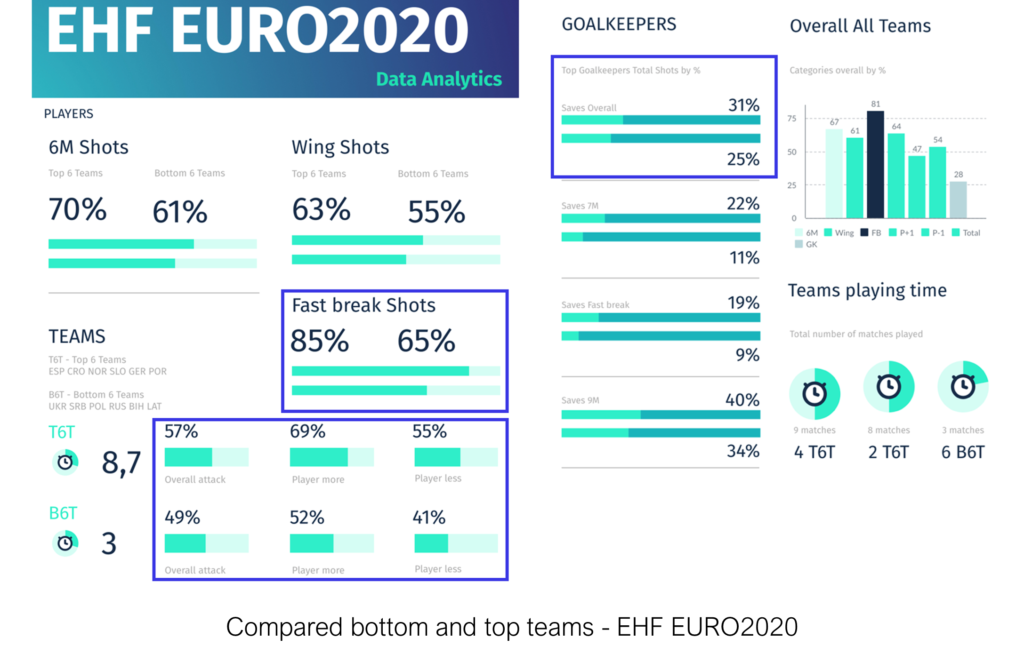
Thus – and knowing that the men’s EHF EURO is the best handball international event – comparing the high level of performance of the elite players presenting there, we proceeded to a verification of evidence to see if there are differences between the teams classified in the first six places and the six that ended in the opposite positions of the ranking (Ashkenazi and Freitas, 2020). We used statistical data and analysis to measure the overall performance of the game and identify relative strengths and weaknesses based on this analysis. The idea was to check if there were relevant differences between the high and low classification teams in the Men’s EHF EURO 2020, and understand if any of the parameters studied could determine the final classification or the final result.
Finally, based on these results and evidence, we recommended to coaches what to take care of in training.
And what we found was that perhaps situations 6vs5 or 5vs6 ( playing with a player more or a player less ) can be determinant for the final result and the final classification. This is, because they can have an impact of +/-10% on the overall efficiency of the attack. And this happens perhaps because the best teams are more effective in 1vsGK situations, as it often happens in those cases.
Moreover, the Gks – as you would expect – play decisive role and seems to have great relevance to the success of their team, in the same way as 1vsGK actions. This has been exposed by the level of shots that have been saving during the EHF EURO2022, significantly determining the successful results of their team.
Considering these results, it is clear that there is no single element that can determine, by itself, the result of a game or the final classification.
In the same direction, are the results found by (Gaza, Andrés, and Tarragó, 2017) which report that the predictive criteria of a team’s performance are a combination of the opponent GK’s saves, technical fouls, steals, and our own GK’s saves.
But the differences are shorter and shorter and often other parameters influence the final result, such as the speed of the game, the quality of the shots, the time of ball possession, the technical fouls provoked.
Anyway, in conclusion, I don’t think we can look at just one criterion or even a pair of them and conclude with certainty that this was decisive for the final victory or final classification.
Given the limitation of the number of data, it seems difficult to me to extrapolate definitive conclusions. Of course, there are patterns, such as the above and as the number of goals scored, the percentage of positional attack vs quick attack that seem to follow a pattern but that need more and better analysis to better infer the game. We still rely a lot upon subjective assumptions to explain a lot of data and maybe this is why we love this sport so much.
Final notes
From my point of view, the speed of the game has increased and we can observe games with 60 possessions of the ball, which consequently makes us think that ball possession time must be shorter. However, the average number of goals scored continues to increase.
Logically, more fast actions and 1vsGK shots will happen – counterattacks, breakthroughs, 6 meters shots and 7 meters shots, either by insufficient defensive recovery, by attack-defense substitutions and poor positioning or because of the mentioned faster pace of the game in general. The number of shots of 9 meters (but not their effectiveness) is falling in recent international events, due to the individual and collective quality of the attack, in general, regarding the attack’s efficiency.
If we have more possessions of the ball, more fast attacks and more goals, perhaps the defense is being less relevant or less able to act successfully.
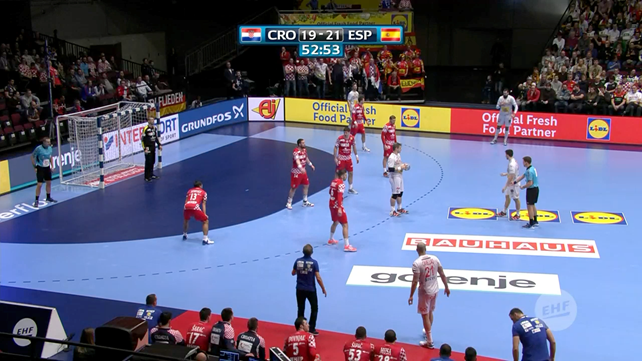
Therefore, the figure of the GK emerges again as a determining criterion for the final victory, with its saves and counterattack or fast throw-offs, providing quick and easier goals.
It seems clear to me that the balance of forces between attack and defense is leaning to the side of the attack, as I remember a famous sentence from Xesco Espar before a former international event, “no matter how we will defend them because, with their quality, they will always score a goal”.
And I don’t think that’s happening because of the surprise that one team can create to the other, by introducing new or unexpected tactical elements into the game, since most teams are playing the same way, using similar actions as the basis of their offensive game.
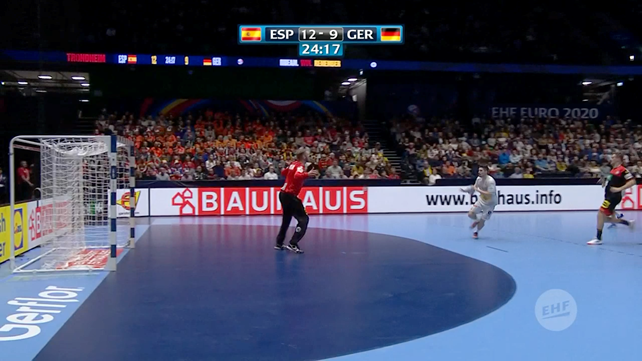
- But somehow, by the pressure placed by the continued attack or third wave of the fast attack. Coaches realized that there are no significant differences between the balls lost in the positional attack and continued attack and optimized more this form of game manipulation.
- For the significance that pivot has been playing in the team’s offensive process, either for its power to obtain advantages in the 2vs2 situations or for the ability to create isolations of defenders due to its intelligence and tactical movement, allowing finishing actions closer to the 6 meter zone.
- By the speed and quality of execution of the wings that anticipate quickly, finishing situations even from short angles.
- For the increasing quality of decision-making of offensive players, in situations of player more or less, but also on 6vs6 offensive plays.
- By increasing the speed of circulation of the ball.
Concluding, if I have to suggest a team’s roster, according to what I have written before and upon the data collected, I would search for the best goalkeeper – that is what Portugal had done when we proceed to the naturalization of unforgettable Alfredo Quintana, a pivot player that can play both ends of the court and above all, a playmaker with a great decision making and fast wings with good shooting abilities.
But overall, we still need to walk a long way to input more data and from there to overstep to new horizons on behalf of relevant statistical game analysis …
Rolando Freitas, Men’s National Teams Sports Director na Israel Handball Federation