“Performance Analysis in Sports”

Introduction
What is performance analysis…
Since the early 2000s, performance analysis in sports has undergone a dramatic transformation in both methods (ie, the integration of advanced statistics and new levels) and technologies (eg GPS tracking, note-taking software and a wide variety of tracking sensors and other data recording equipment). What started out as pen and paper abbreviations have since evolved into advanced computer systems and technologies that collect huge amounts of performance-related data.
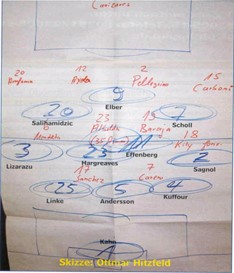
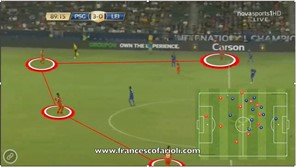
Analysis then and now ...
The rise of lucrative financial opportunities in most major sports, thanks to ever-increasing revenue from television deals and a growing global audience, has inevitably increased demand. As a result, sports organizations are now turning to more scientific, evidence-based approaches when it comes to managing their infrastructure and developing their athletes.
The standards in elite sports for achieving and maintaining success are constantly increasing, putting increasing pressure on clubs, coaches and athletes to develop more effective training structures, enhance athlete development processes and better understand the factors that determine success in big tournaments.
Attempting to give a definition, Sports Performance Analysis could be considered as the observation, recording and analysis of data and events that take place on the field (training or competition), with the aim of providing assistance in acceleration and improving the performance of the athlete or team.
Research has shown that after the first 10 minutes of continuous monitoring life there is a decrease in attention and concentration.
Weinberg, R., & Gould, D., (1995)
Foundations of Sport and Exercise Psychology, Chapter 18, p. 333 – 357 Campaign, IL : Human Kinetics
Who performs performance analysis …
Extremely competitive environments, with increasingly limited margins, have led to the emergence of Performance Analysis as an independent, but interdisciplinary, supportive function that specializes in objective, and more often quantitative, performance appraisal. This relatively new field, aims to assist coaches in identifying key areas of performance that require labeling, evaluating the effectiveness of tactical and technical performance, and the strengths and weaknesses of oncoming opponents. Therefore the role of analyst can be performed by the Coach himself, the Assistant Coach or consequently the video analyst, a modern role that appears in the sports staffs, either as an individual member or as a team (analysis) with distinct roles in the objects of analysis.

Boxing analyst
The aim is to provide valid, accurate and reliable information to coaches and athletes to increase their knowledge in a specific area of each sport.
Which are the categories of performance analysis…
In general, performance analysis can be classified into two main categories:

NOTATIONAL ANALYSIS

MOTION ANALYSIS
The two systems have a different focus. The analysis with notes provides real data about the action field, the participating athletes, the relative action, the time, the result of the athlete’s action, etc. Motion analysis focuses on raw features of a person’s activity and movement, for example, evaluating movement, determining fatigue, measuring work rate, etc. In other words, note analysis is the collection and analysis of information obtained from the objective observation of performance (individual, team) in a competitive situation (eg phase, match, training). (Coaches Colleague, 2009) and respectively motion analysis is the process of classifying activities and movements according to the intensity of the movements (Strudwick and Reilly 2001) and the primary characteristics of an athlete’s activity and movement. (Carling et al., 2005).
The main difference between the two categories is that the motion analysis is performed exclusively with the use of electronic means while the analysis with notes can also be performed with conventional means (handwritten notes, drawings, etc.)
What are the uses of performance analysis in the training process…
In order to understand the necessity of performance analysis, we must first implement the stages through which the transition from training to competition takes place (performance) and which are determined by the coaching cycle.
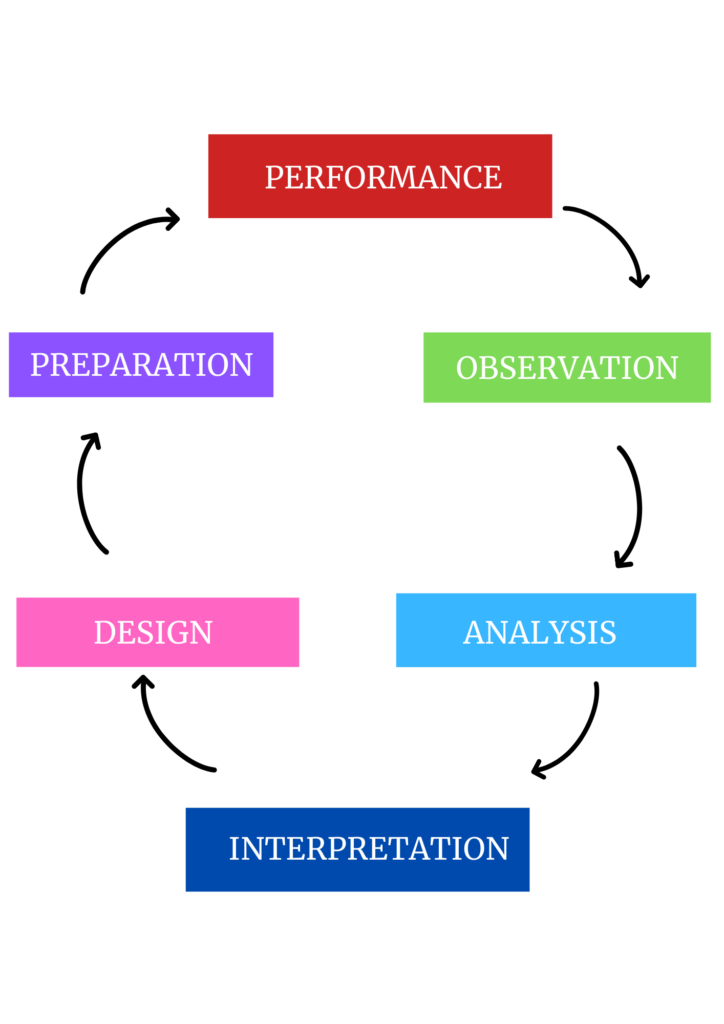
The coaching cycle …
It is therefore obvious that performance analysis participates decisively in 3 stages of the coaching process according to the coaching cycle and these are Observation, Analysis and Interpretation.
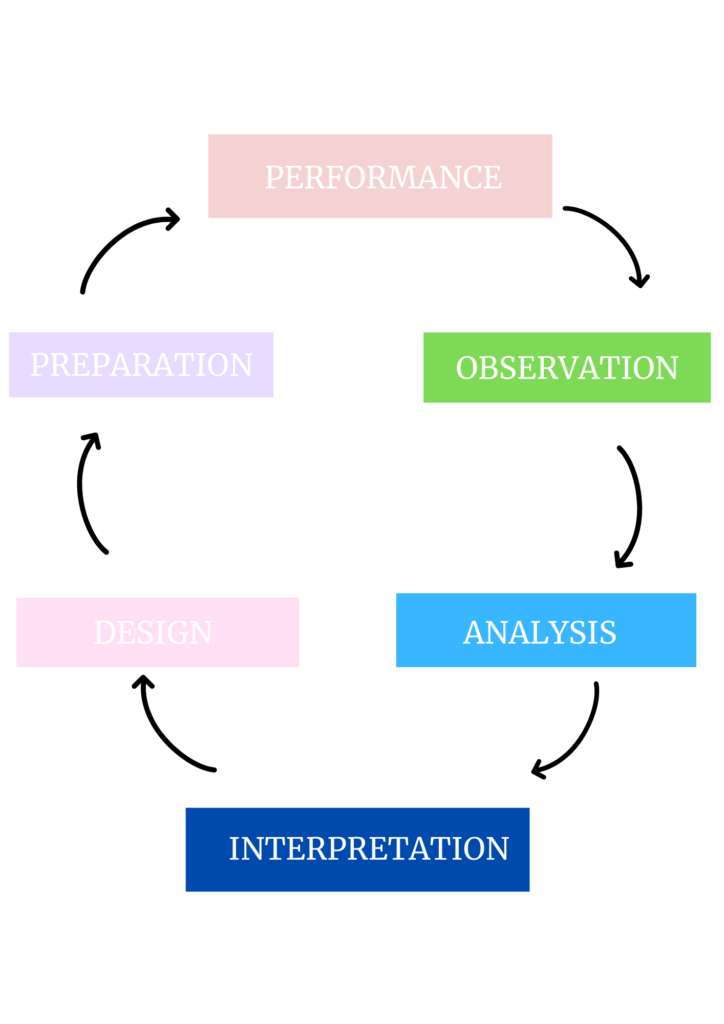
Prerequisites for a successful performance analysis…
It should first be noted that the use of certain statistics can lead to the misunderstanding of significant unstable factors in the performance of an athlete or team. We conclude that the ideal condition for an integrated performance analysis is the combination of statistics and big data with the coding, isolation and visualization of sports activities (video analysis). Furthermore, the correct use of the 3 defining stages of the coaching process according to the coaching cycle is achieved when:
– Observe, analyze and interpret the mistakes (or weak points) that occur repeatedly, in order to plan and prepare their exploitation (opponent) or their prevention (athlete or team) !!!
– Observe, analyze and interpret the possible advantages that take place repeatedly, in order to plan and prepare for their confrontation (opponent) or their repetition (athlete or team) !!!
Whatever happens once may not happen again. But whatever happens twice will definitely go again …
Paulo Coelho – The Alchemist (p. 240)
KONSTANTINOS BRATSOS
- FOOTBALL COACH UEFA A’ – VOLOS F.C. ASSISTANT COACH / VIDEO ANALYST
- PERFORMANCE ANALYSIS